
Legacy data pipelines can keep running for years and still hold a business back. Built for yesterday’s data volumes and reporting needs, traditional ETL jobs, manual transfers and tightly coupled batch workflows become harder to maintain, slower to deliver data and difficult to connect to cloud and AI tools.
The answer is rarely to rip everything out. The same pipelines feed financial reporting, customer operations and supply chain decisions, so the real task is to modernize them while the business keeps running.
This article covers why pipelines age badly, why a full replacement is risky, and a phased approach that protects continuity at every step.
Why legacy pipelines become a business problem
Pipelines are designed around the systems and requirements that existed on day one. As the organization grows, four problems tend to appear.
- Rising maintenance cost. Custom scripts, manual fixes and specialized know-how make upkeep expensive. Even a small change, such as a new data source or report field, can mean significant development and testing.
- Delayed information. Scheduled batch jobs move data at fixed intervals. Reporting, forecasting and operational decisions then run on data that is hours or days old.
- Limited scalability. Growing volumes and new applications strain older infrastructure, and adding capacity is costly. New data formats and sources often don’t fit the original design.
- Hard to integrate new technology. Cloud platforms, analytics tools and AI applications struggle to connect to legacy databases, which leaves disconnected workflows and extra integration work.
Why replacing everything at once is risky
A full replacement looks like the cleanest fix, but these pipelines often support financial reporting, customer operations, supply chain processes and enterprise analytics. Switching all of them at once exposes the business to:
- Disrupted workflows during cutover
- Data inconsistencies between old and new systems
- Compatibility problems that only surface in production
- Higher implementation costs and longer timelines
- Delays to business-critical reports and applications
A more practical route is incremental: keep existing systems running while new capabilities are introduced and proven.
A phased approach to modernizing data pipelines
Successful modernization follows six steps, each one limiting risk before the next begins.
1. Assess the current environment
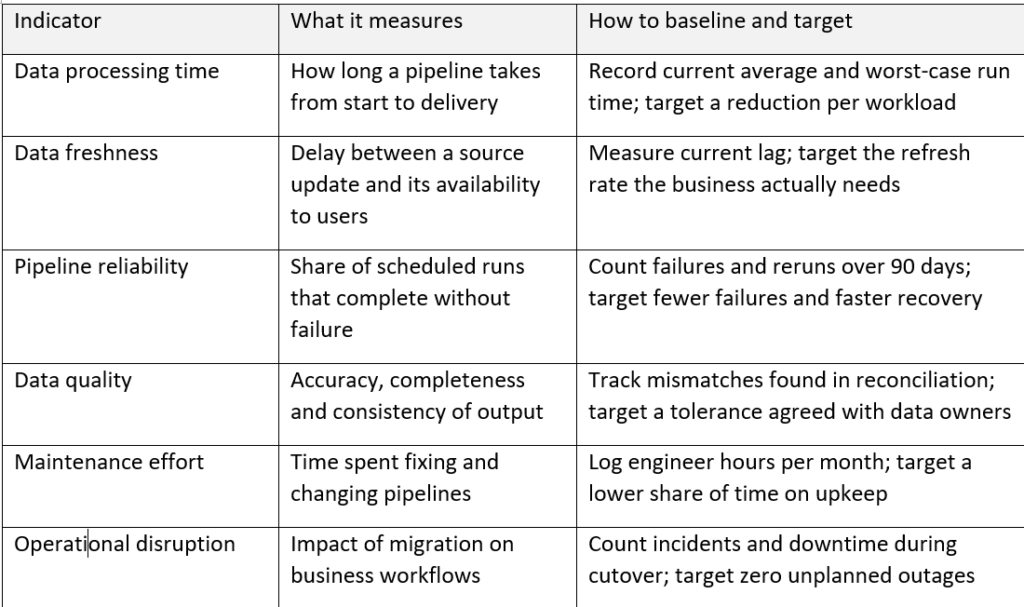
Map how data moves today: sources, dependencies, schedules, integration methods and the business applications that rely on each pipeline. Record a baseline for run time, failure rate and maintenance hours, because you will need it to prove improvement later. The goal is to find bottlenecks, redundant processes and undocumented manual steps.
2. Prioritize high-impact workloads
Not every pipeline needs to move now. Rank them by business importance, operational risk, maintenance effort and performance gaps. A finance reporting pipeline that regularly delays month-end close should come before a stable process that already meets its requirements.
3. Migrate in phases
Move selected workloads in stages: one data source, one ETL process or one reporting domain at a time. Run cloud services alongside existing infrastructure rather than instead of it. Where the business needs fresher data, consider change data capture (CDC) or streaming for those specific flows instead of rebuilding everything as real time.
4. Validate with a parallel run
Run old and new pipelines side by side for a defined period, such as one full business cycle or month-end close, and compare outputs. Reconcile row counts, checksums on key fields and aggregated totals, and agree in advance what tolerance is acceptable. Investigate every mismatch before trusting the new pipeline.
5. Cut over with a rollback plan
Switch consumers to the new pipeline in a planned window, with named owners and a tested way back to the legacy workflow. Keep the old pipeline available, but not running in production, until the new one has passed a full cycle. Build security, access control and compliance checks into the migration plan from the start, not after cutover.
6. Monitor and hand over
Track processing time, data freshness, failures, resource use and data quality after go-live, with alerts for each. Document the new pipelines and train the teams who will run them, since modernization fails quietly when only the original builders understand the system.
Choosing a modern data platform
Pick the platform after the assessment, not before it. As a general guide, each of the three common options tends to fit a different starting point.
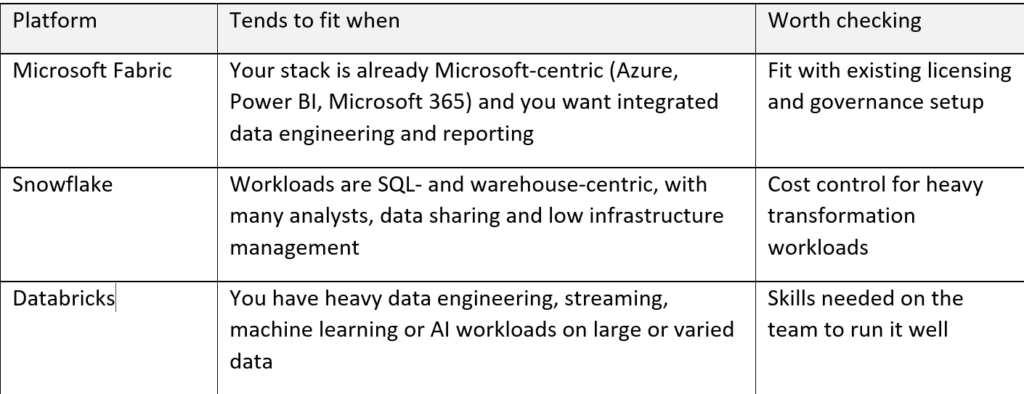
In practice, the right choice also depends on data volumes, integration needs, existing skills and long-term business goals. Many enterprises run more than one.
Measuring the success of modernization
Measure each indicator before migration, then set targets from that baseline so improvement is provable.
Conclusion
Modernization succeeds when you assess first, prioritize by business impact, migrate in phases and validate before you switch. The measure of success is not how fast the legacy infrastructure disappears, but how much better the data works for the business while operations keep moving.
The goal is not simply a modern pipeline. It is one that works better for the business, without interrupting what already works.
Planning a pipeline modernization? Talk to our data engineering team about an assessment of your current pipelines, a prioritized roadmap and a phased migration plan.
Frequently asked questions
1. What is legacy data pipeline modernization?
It is the process of upgrading or redesigning the processes that collect, transform and move data across enterprise systems, to improve reliability, scalability, performance and accessibility.
2. Does modernizing data pipelines require replacing existing systems?
No. A phased strategy introduces new technologies and workflows while keeping existing systems wherever they still meet business needs.
3. How can businesses minimize disruption during data migration?
Prioritize workloads, migrate in phases, run old and new pipelines in parallel, validate outputs and monitor continuously, with a tested rollback plan at cutover.
4. What is a parallel run?
A period in which the legacy and new pipelines process the same data side by side, so teams can compare outputs and fix differences before retiring the old workflow.
5. How long does pipeline modernization take?
It depends on the number of pipelines, their dependencies and the state of the data. A single well-understood pipeline can move in weeks, while a full enterprise estate is usually a multi-phase program lasting many months.
6. What is the difference between ETL and ELT?
ETL transforms data before loading it into the target system. ELT loads raw data first and transforms it inside the platform, which suits cloud platforms with scalable compute. The right choice depends on data volumes, governance needs and the platform you use.
7. Which platforms support modern data pipeline development?
Microsoft Fabric, Snowflake and Databricks all support data integration, processing, storage and analytics. The best fit depends on your technical environment and business needs.